Essay · On Revelation
Always the Lamb
The story behind the song — and why the way into Revelation is not through the lock, but through the curtain.
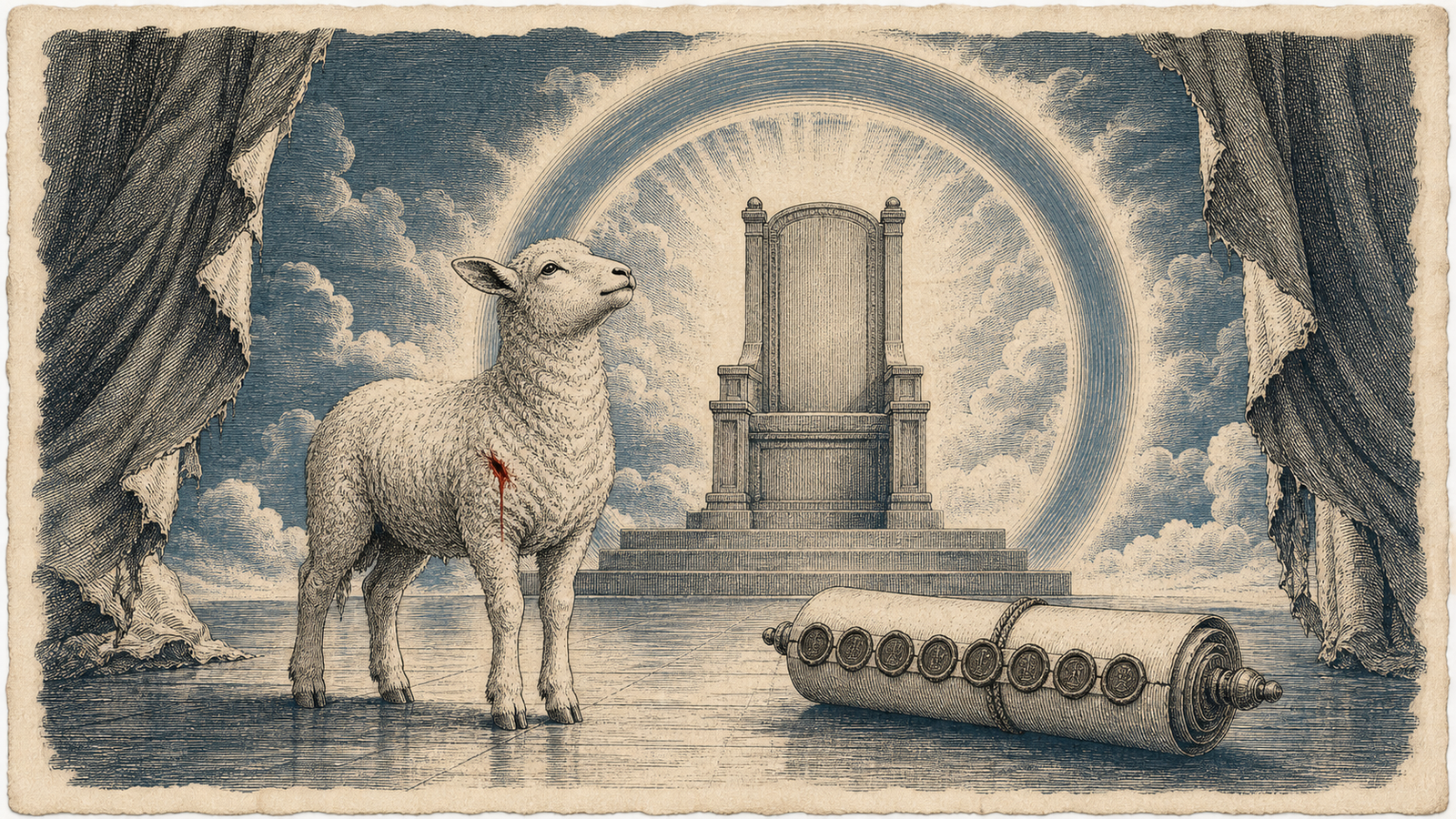
Revelation is the only book in the Bible named for what it does. Its first word in Greek is apokalypsis — an unveiling, a curtain pulled back. The book announces itself, in its very first line, as "the revelation of Jesus Christ."
And yet no book of Scripture has been treated more like a vault. We've read it with stopwatches and highlighters, matched its beasts to our headlines, drawn its timelines on whiteboards, and argued about its sequence like engineers reverse-engineering a machine. A book that calls itself an unveiling has been handled, for generations, as a concealment — a cipher waiting for the right generation of code-breakers.
"Always the Lamb" came out of a long love for this book, and a growing conviction that the way into it is not through the lock but through the curtain. This is the story of what the song is doing, and why.
What kind of book is this?
Revelation didn't fall out of the sky as a genre of one. It belongs to a family of Jewish writing called apocalyptic — the visionary literature of Daniel, Ezekiel, and Zechariah — with its own native language of thrones and beasts, numbers and colors, stars falling and seas turning. First-century readers knew this language the way we know the language of political cartoons. When a beast rises from the sea wearing crowns, nobody in the seven churches of Asia Minor reached for a field guide to marine biology.
And that's the key: Revelation was written to somebody. Seven real congregations, in real cities, under the real weight of an empire that stamped Caesar's face on its money and demanded he be called Lord. John writes to them about things that "must soon take place," about a time that is "near." Any reading that makes the book indecipherable to its first readers — a message in a bottle floating past twenty centuries of Christians until it finally washes up on our particular shore — has taken a wrong turn somewhere.
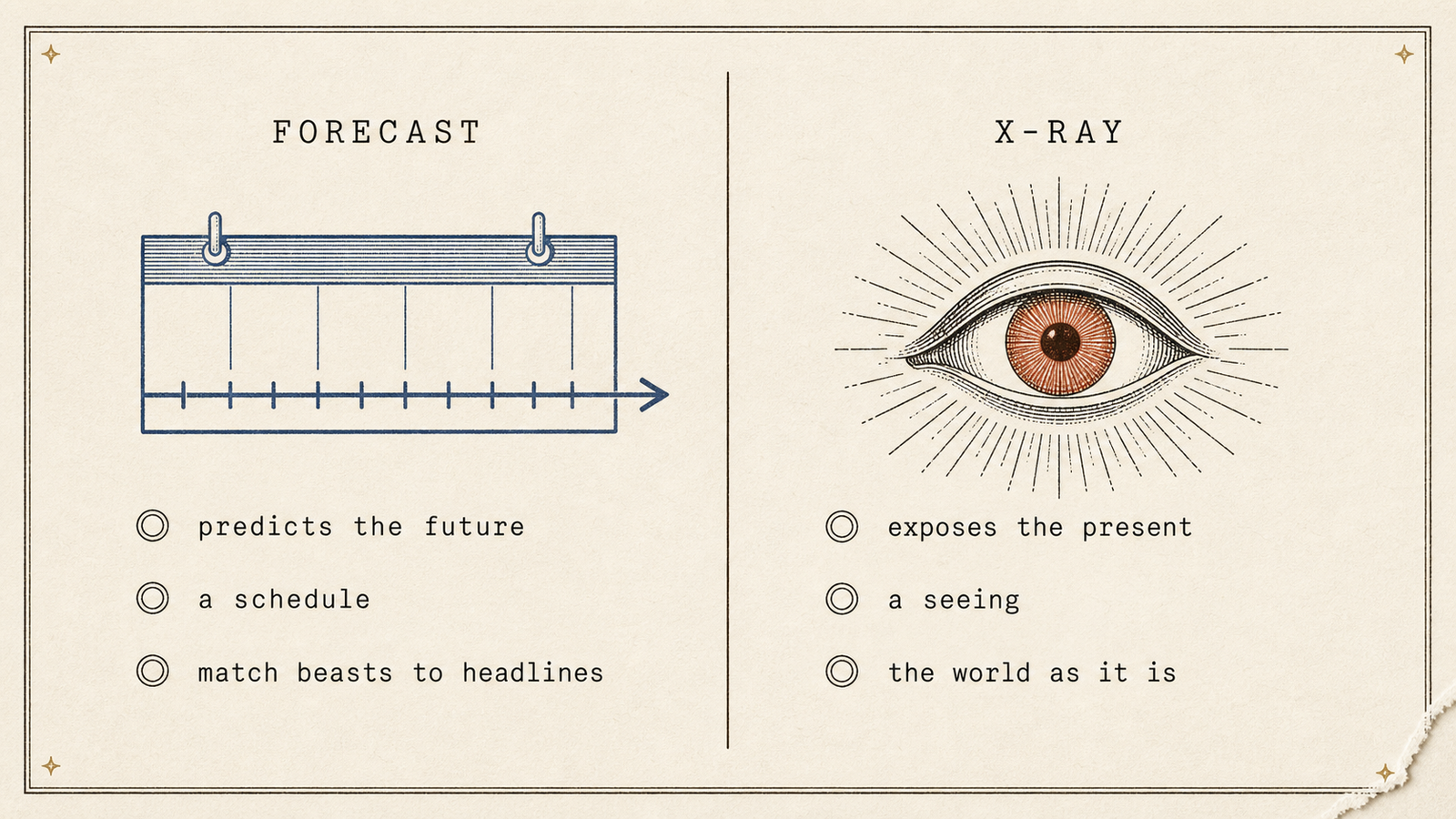
Because an apocalypse doesn't primarily predict the future. It exposes the present. It's less a forecast than an X-ray. To churches for whom Rome looked eternal and resistance looked pointless, John's vision pulls back the curtain on the world as it actually is: the empire is not what it appears, the martyrs are not losing, and the throne of the universe is not empty. That's the unveiling. Not a schedule — a seeing.
The scene the whole book turns on
Revelation 4 opens with a door standing open in heaven and a voice like a trumpet saying, "Come up here." John is taken into the throne room: an emerald-ringed throne, lightning, a sea of glass like crystal, elders casting their crowns down before it. This is where the song's first verse lives, and where the chorus takes its posture — every crown coming down, every knee bowing low — before settling on the confession heaven never tires of: worthy is the Lamb.
Even the song's grammar is borrowed from John. His favorite way to open a scene — and I saw — tolls through Revelation dozens of times, so the verses simply keep his cadence: I saw a door, I saw a throne, I saw the Lamb.
Then, in chapter 5, the drama. There's a scroll in the hand of the One on the throne — sealed shut. And a question rings out: who is worthy to open it?
No one answers. No one in heaven, no one on earth. And John — the seer, the one granted the vision — does not crack the code. John cries. He weeps loudly, because it seems the scroll of history's meaning will stay shut forever.
Then an elder tells him to stop weeping: the Lion of the tribe of Judah has conquered. John turns to see the Lion — and sees a Lamb, standing as though it had been slain.
He hears a Lion; he sees a Lamb.
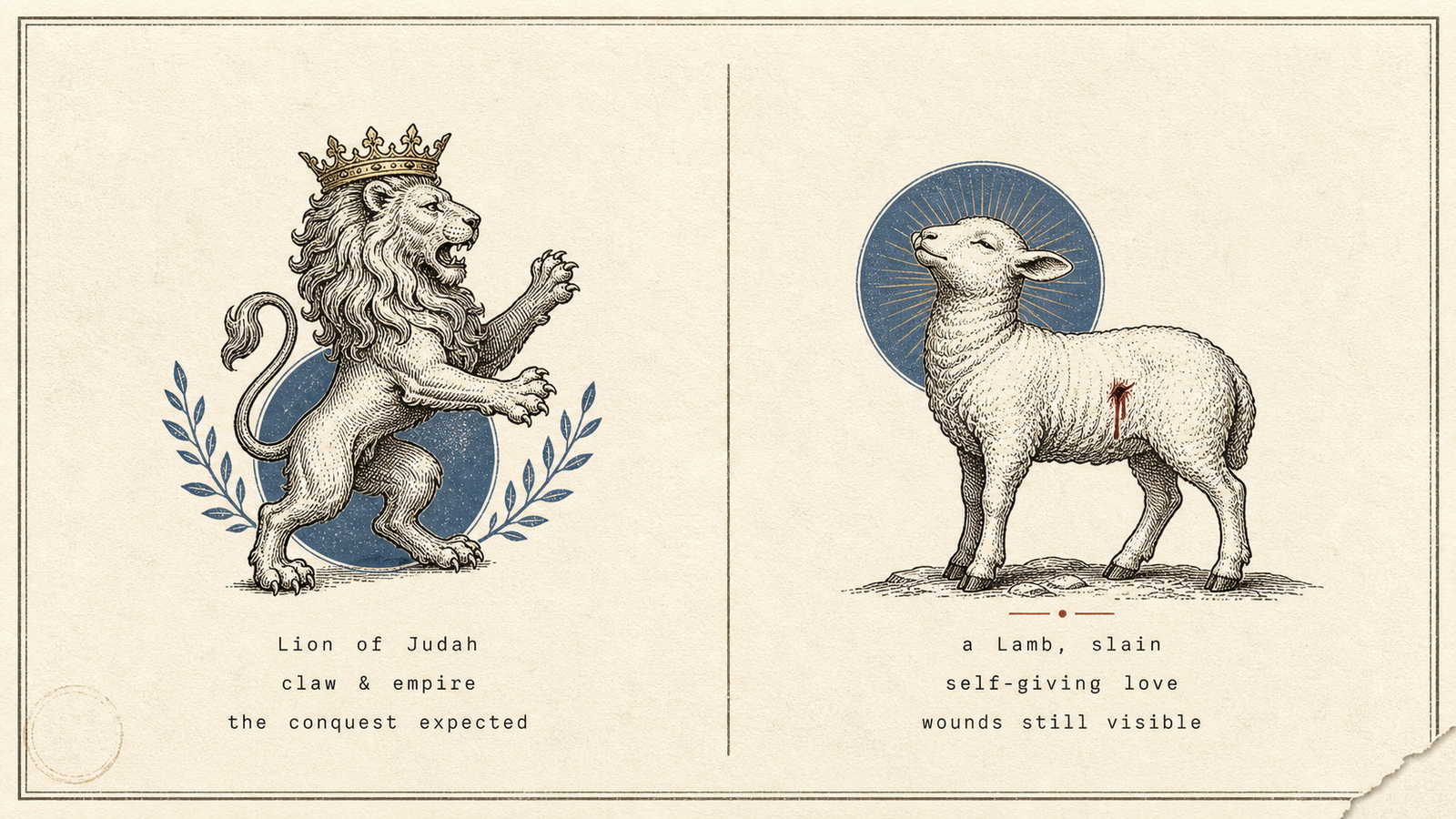
The whole book pivots on that turn of the head. Conquest itself has been redefined at the throne of God: the victory that opens history's scroll is not the victory of claw and empire but of self-giving love, wounds still visible, standing. And notice who opens the seals. Not the reader. Not the clever. Only the Lamb. The meaning of history was never ours to crack; it was always His to open.
That's the line the whole song hangs on: it was never a code to be cracked — it's the curtain torn, the veil pulled back. Even that image comes from Good Friday, when the temple curtain tore from top to bottom. The first great unveiling was the cross. The Revelation was always the Lamb.
A book that ends at a wedding
Skip to the end and you find something remarkable: the Bible's final vision is not a war room. It's a wedding. A city comes down out of heaven "prepared as a bride adorned for her husband." God moves into the neighborhood — "the dwelling of God is with man." A river runs from the throne through the middle of the street; a tree grows on its banks whose leaves are for the healing of the nations. No more sea, no more night, no more death. And this: "He will wipe away every tear from their eyes."
Here is the quiet architecture of the song. In verse two, the singer weeps John's tears — no one is worthy. In verse three, the hand that was pierced wipes those same tears away — the Lamb's, still standing as slain. The last book of the Bible opens its throne scene with a man crying and closes with God drying every eye. I wanted the song to travel that exact distance, so that the tears you sing in the second verse are the ones being wiped in the third.
Hope without a countdown
The bridge begins with a confession that some find strange in a song about the end: I don't know the day or the hour. But that isn't a shrug — it's a quotation. When Jesus himself was asked about the timing of the end, he answered that no one knows the day or the hour, not the angels, not even the Son — only the Father. If the Son of God could carry his mission without the date, the church can carry hers. Christian hope has never depended on the math coming out right.
What it depends on is stranger and better. The letter to the Hebrews reaches for a nautical image — hope as "an anchor of the soul" — and then throws that anchor in an unexpected direction: not down into the sea, but forward, behind the veil, into the sanctuary of God, "where Jesus has gone as a forerunner on our behalf." It's the only time the New Testament uses that word, and it uses it for Him. Our future is not secured by our forecasts. It is secured by His presence there already. The bridge sings it plainly: my Forerunner's behind the veil, and He went ahead of me.
Which is why the bridge can risk its boldest line: the end is not a mystery. That sounds like a contradiction — didn't the same bridge just confess we don't know the day or the hour? But that's precisely the claim. The when is hidden; the Who is not. The dragon is already down, the grave is already open, and a hope anchored behind the veil doesn't need the schedule. We haven't decoded the ending. We've met Him.
Then comes the stop — the moment the whole arrangement is built around. The band climbs and climbs on "You're making all things new," and then everything cuts to silence. There's a warrant for that in the text, too: when the seventh seal is finally opened, what comes out is not thunder but "silence in heaven for about half an hour." Revelation scores a rest into heaven's own liturgy. So the song does the same — and into that silence comes one of the only lines in the book spoken directly from the throne: "Behold, I am making all things new." When God finally speaks in this book, He does not announce a timeline. He announces a renovation.
The two invitations
The song opens with heaven's word to John: "Come up here." It closes with the church's word back: "The Spirit and the Bride say, 'Come.'" The entire book — and the entire Christian life — is lived between those two invitations. The Bride's whole vocation, in the end, compresses into a single word. Not calculating. Not decoding. Longing. It is the oldest recorded prayer of the church — Maranatha, come, Lord — and it is the last prayer of the Bible: "Amen. Come, Lord Jesus."
The song builds that handoff into its final minute. The last wall of sound is heaven's own title for God — who was, and is, and is to come — and the church answers the final word of that doxology with hers. "…And is to come." Come. The name becomes the prayer.
Revelation, it turns out, is the most musical book in the New Testament — packed with more songs, doxologies, and shouted choruses than anywhere else in Scripture. That's not decoration. It's the point. The book was given to make worshipers, not chart-makers.
And notice what heaven's music is like: repetitive. The four living creatures around the throne never stop, day or night, singing the same three words — holy, holy, holy. Heaven is not embarrassed to sing one line forever. So the song keeps its words few and says them again and again — one melody carrying every verse, one refrain returning until it lives in your bones — because that's what adoration sounds like when it stops performing and settles in. Worthy is the Lamb. Worthy is the Lamb.
So pull back the curtain — on history, on empire, on suffering, on the future itself. What's behind it is not a schedule. It never was.
It was always the Lamb.