Essay · On Mark and Jonah
The Storm Was the Smaller Thing
Mark 4 tells a storm story. Anyone raised on the Hebrew Bible would have heard Jonah shouting through every line of it.
Call and Response
If you grew up in a liturgical church, you know the reflex. Someone at the front says, "The Lord be with you," and before your brain has signed off on it, your mouth is already saying, "And also with you." You don't decide to answer. The first half of the line pulls the second half out of you. You could be at a ballgame, half asleep, thinking about lunch, and if somebody said those words you would answer them.
Ancient Israel's Scriptures worked like that for the people who grew up inside them. Say the first half of a line from the Tanakh, the Hebrew Bible, and a whole room could finish it.
Which is why I nearly fell out of my chair reading Mark 4 today when I heard something that prompted me to check the Greek.
The story is familiar. Jesus and his disciples cross the Sea of Galilee at night, a storm hits, Jesus is asleep, they wake him, he calms the sea. But one word keeps showing up. The storm is a λαῖλαψ μεγάλη (lailaps megalē), "a great windstorm" (4:37). When Jesus speaks, there is a γαλήνη μεγάλη (galēnē megalē), "a great calm" (4:39). And afterward the disciples ἐφοβήθησαν φόβον μέγαν (ephobēthēsan phobon megan), they "feared a great fear" (4:41).
Great storm. Great calm. Great fear. Three times in five verses. That would be unremarkable in some writers, but Mark writes like a man running to catch a bus. He almost never stops for an adjective. When he says "great" three times, he's leaning on the first half of a line he expects you to finish.
That line belongs to Jonah.
Jonah Was in the Room
For anyone in Mark's first audience who was steeped in the Tanakh, Jonah wasn't a kids' story about a fish. It was short, dramatic, funny, and read aloud a lot. Jewish tradition eventually made it the reading for the afternoon of Yom Kippur, the holiest day of the year (the Talmud records the custom at Megillah 31a). It was part of the furniture of the mind.
And Jonah's first chapter is obsessed with the word "great." The Hebrew is גָּדוֹל (gadol), and the book uses it more than a dozen times in four short chapters: a great city, a great wind, a great storm, a great fear, a great fish. In the Greek translation many of Mark's hearers would have known, the Septuagint, the storm in Jonah is a κλύδων μέγας (klydōn megas), "a great surge" of the sea (1:4).
Now lay the two stories side by side and watch the furniture line up.
There's a boat in a storm about to break apart. There's a man asleep below while everyone else panics. Jonah is down in the hold, and the Greek translator, bless him, has him snoring. The captain shakes him: Τί σὺ ῥέγχεις; (ti sy rhencheis), "Why are you snoring?" (1:6). Jesus is in the stern, asleep on a cushion. Both sleepers get woken by people afraid of drowning. Jonah's captain begs him to pray "so that we do not perish" (μὴ ἀπολώμεθα, mē apolōmetha). Jesus' disciples cry, "Teacher, don't you care that we are perishing?" (ἀπολλύμεθα, apollymetha, Mark 4:38).
There's even a shared verb. Jonah tells the sailors that if they throw him overboard, the sea will quiet down: κοπάσει ἡ θάλασσα (kopasei hē thalassa, 1:12). When Jesus speaks to the wind, it ἐκόπασεν (ekopasen), "quieted down" (4:39).
To be fair, Mark isn't copying and pasting. His storm is a different word, λαῖλαψ, a squall, not Jonah's κλύδων. And Jonah never gets a "great calm." His sea simply "stood still from its raging" (1:15). Mark isn't quoting Jonah. He's echoing him, close enough that anyone who knows Jonah can't miss it.
And the sleeper has been flipped. Jonah is asleep because he's running from God. Jesus is asleep because there's nothing on that lake he's afraid of. In Jonah, the man sleeping in the boat is the problem. In Mark, he's the solution.
The Fear Gets Bigger
The real payoff of the echo, though, is the fear.
Watch Jonah's sailors. When the storm hits, they're afraid (1:5). When Jonah admits he's running from the God "who made the sea and the dry land" (1:9), they "feared a great fear" (1:10), the very phrase Mark uses, ἐφοβήθησαν φόβον μέγαν. Then they throw Jonah over the side, the sea goes still, and you'd expect everyone to exhale.
They don't. Their fear gets bigger, and it finally gets a name: the men feared the LORD with a great fear, φόβῳ μεγάλῳ τὸν κύριον (phobō megalō ton kyrion), and they offered a sacrifice and made vows (1:16).
That's the shape of Jonah 1. The storm is scary. The God behind the storm is scarier. And the moment the danger passes is the moment the fear peaks, because now you've seen who you're dealing with.
Mark follows that arc beat for beat. In the middle of the storm, the disciples are scared, and Jesus calls them δειλοί (deiloi), "timid" (4:40). Then the water goes flat as glass, and that's when the great fear shows up.
And here is where a Jonah-soaked listener would have grabbed the edge of the bench. At the exact moment where Jonah names the one the sailors fear, the LORD, YHWH, the God of Israel, Mark doesn't say the name. He asks a question instead: τίς ἄρα οὗτός ἐστιν; (tis ara houtos estin), "Who then is this, that even the wind and the sea obey him?"
Jonah's sailors feared the God who made the sea. Mark's disciples are afraid of the man sitting in their boat.
The Answer Everyone Knew
If you grew up in the Tanakh, you didn't need anybody to answer that question for you. The Psalms had been answering it your whole life. The LORD rules the raging of the sea (Ps 89:9). He rebuked the Red Sea and it dried up (Ps 106:9). Psalm 107 even tells about sailors caught in a storm who cry out to the LORD, and "he made the storm be still" (107:29). In Israel's Scriptures, only one person tells the sea to be quiet and gets obeyed.
Look at what Jesus actually says to the water: σιώπα, πεφίμωσο (siōpa, pephimōso), "Hush. Be muzzled." It's the verb for muzzling an ox (Deut 25:4), and Jesus used it on a demon back in Mark 1:25. He talks to the sea the way you'd talk to something that had gotten loose, and the sea shuts its mouth.
There's one more turn, and it's the one that gets me. In Jonah, the sea only goes quiet when a man goes over the side. Someone has to go down into the deep so everyone else in the boat can live. In Mark 4, Jesus doesn't go overboard. He just stands up and speaks.
But Mark isn't done with Jonah. That part of the story is still coming, later, on a hill outside Jerusalem, where a man goes down into death so the people in the boat can live. Matthew has Jesus say it out loud: "something greater than Jonah is here" (Matt 12:41). Mark lets you work it out yourself.
That's the whole trick of this passage. Mark says the first half of the line. Great storm. Great calm. Great fear. Then he stops, and he asks, "Who then is this?" Anyone raised on Jonah already has the rest of the line in their mouth before they decide to say it. In Jonah, the great fear was always followed by the same two words: the LORD.
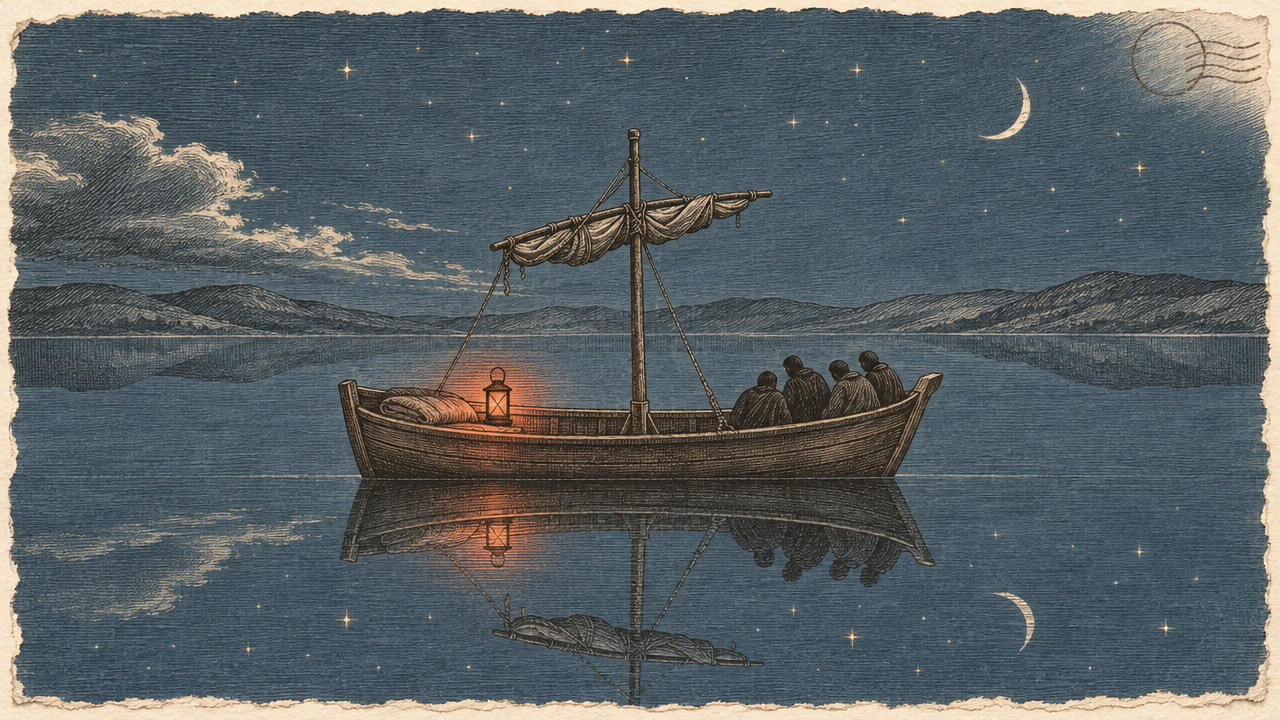
So there they sit, a boatful of disciples on water as flat as glass, more frightened than they were in the storm, staring at the man in the stern.
Sources
- Nestle-Aland, Novum Testamentum Graece, 28th ed. (Deutsche Bibelgesellschaft, 2012), Mark 4:35–41.
- Rahlfs and Hanhart, eds., Septuaginta, rev. ed. (Deutsche Bibelgesellschaft, 2006), Jonah 1.
- Elliger and Rudolph, eds., Biblia Hebraica Stuttgartensia, 5th ed. (Deutsche Bibelgesellschaft, 1997). גָּדוֹל in Jonah 1:2, 4 (×2), 10, 12, 16; 2:1; 3:2, 3, 5, 7; 4:1, 6, 11.
- Babylonian Talmud, Megillah 31a (Jonah as the Yom Kippur afternoon reading).
- Translations of Greek and Hebrew are my own.
The storm was the smaller thing in the boat that night.